


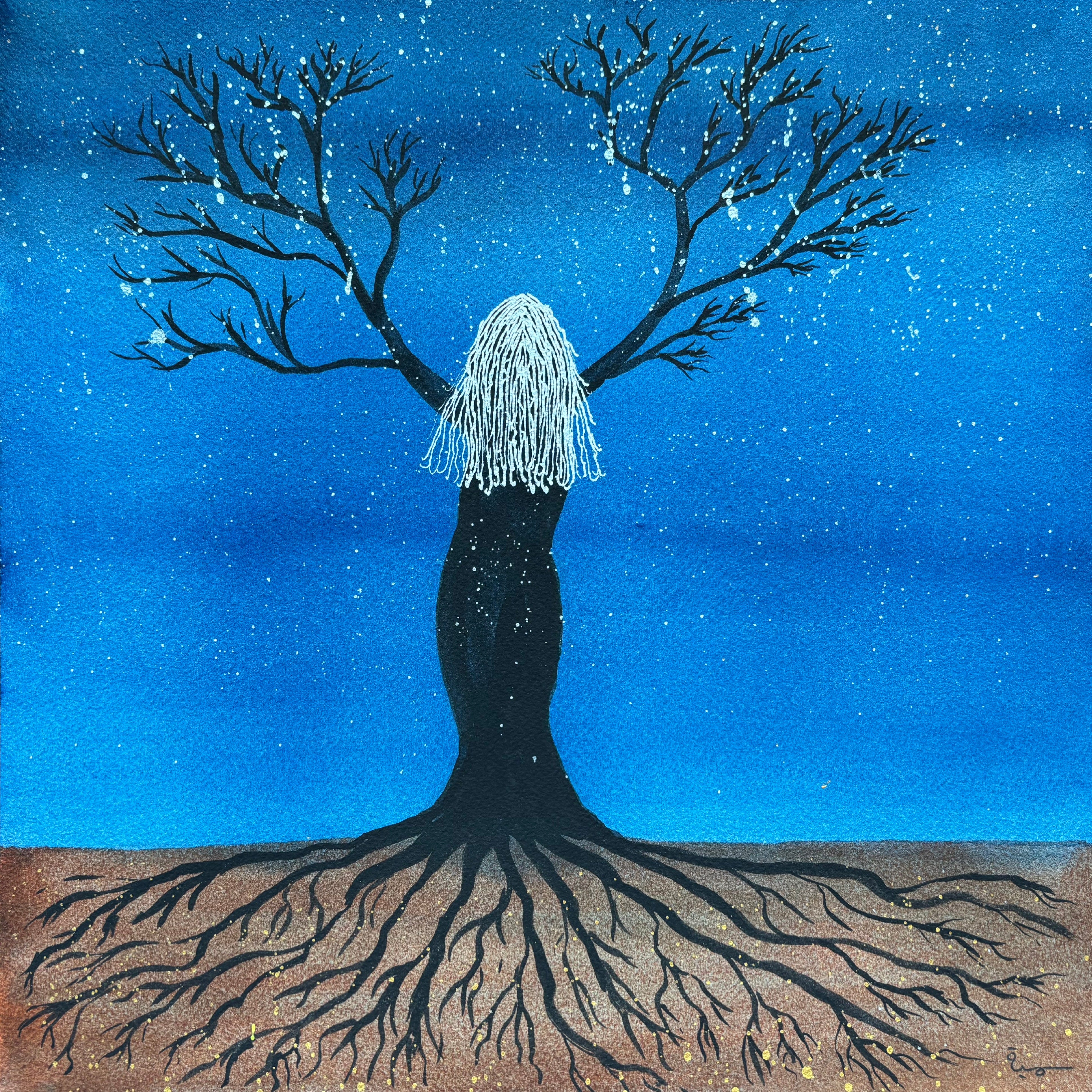
I had never learned

Never learned
what it means
for an ancient design
to be assaulted by the
impossible overwhelm
of modern life.

And I had forgotten

Forgotten the wisdom woven
right into the very fabric of me,
into the mycelial depths
that make me,
hold me,
keep me laced
into the ancient intelligence

of trees
and rivers
and stars.

It was time to learn.

It was time to remember.

My big “aha”
Neck pain. Insomnia. Irritable bowel. Exhaustion. Brain fog. Sensory sensitivity. Post-exercise Malaise. Occipital Neuralgia. Post-concussion Syndrome. Central Sensitivity Syndrome. Long Covid.
An impossibly long list of symptoms and syndromes. Were they related? Or were they separate issues? Did each one need a different specialist, medication or intervention?
None of this made sense.
Until June 2, 2022, that magical day when I finally heard something that might explain everything.
Sitting out on a picnic blanket under the impossible blue of a Colorado sky, listening to my friend Dina share what she was learning about chronic pain and chronic illness, I had my big aha moment.
Fear… Trauma…Nervous system…Brain…Stuck. This is me.
I knew in my bones, without knowing the whats or hows, that this explained all my symptoms. I didn’t need injections, medications, and treatments for each thing as if it were separate from the whole. I was not a robot with malfunctioning parts, needing a little oil here, a tightened screw there. My system, and all its desperate screams, were a whole with an underlying dysfunction, or maybe an underlying need, that I didn’t yet understand.
It was time to listen and time to learn
Baby steps
Ever my champion, Jason searched high and low for a resource to get me started in this new direction. What he found was an online course offering simple exercises to give the nervous system its first sips of safety after being locked in a trauma response for a long time.
Empowered with new tools, I started my days with a new routine. I poured a cup of tea, headed outside into the early morning light, and found a rock to sit on to start my “vagal toning” excercises: slowly and gently stroking the back of my hands together; a gentle squeeze of my arms, like giving myself a hug; slow, deep breathing as I let my eyes feast of the beauty of the sun peeking over the mountains; putting gentle pressure on the spots of tension around my eyes and jaw; humming a little tune.
By the end of my “rock time”—as I came to think of it—I experienced a miraculous reprieve: a little ease and a newfound distance, however tiny, between me and the discomfort, me and the fear.
It was thrilling.
Thrilling, but short-lived. Within a few hours (if I was lucky!), my body and mind would contract again. I would once again feel the knot in my belly, the tension in my jaw, the uptick in the pain in my neck, the drastic dip in energy. And the dark thoughts.
Instead of giving in to it, as I had for so long, I headed back outside, this time to a new rock, a new place to sit, and begin again.
Touch. Hug, Breathe. Hum. Soak in the trickle of relief.
And like that, one rock and one breath at a time, the earth literally held me up, with her body, her bones, supporting me in these baby steps towards a new conversation with my body.
And supporting me to reclaim enough capacity to take the next step.
Curable
The next step was an app.
I had gone to the best physicians in the country, but in the end, I found the information and support I needed from an app. Dear one, as tempting as it is to say more here, the irony is so glaring that I’ll leave it to you to enjoy (or rail against).
The app is called Curable. Informed by the neuroscience of pain—and guided by physicians, therapists and somatic coaches—it was designed to help people recover from chronic pain and chronic symptoms that don’t have obvious structural causes and are considered “incurable.” This includes everything from joint pain to migraines, pelvic pain to nerve pain. It also includes a long list of “syndromes” and illnesses that have recognizable symptoms but no known root cause. Illnesses like Irritable Bowel Syndrome, Post-Concussion Syndrome, Central Sensitization Syndrome, Long Covid, and Occipital Neuralgia. In other words, all of my diagnoses.
I used the app on my own for several months, moved on to a 12-week online group program, and then put the cherry on top by working one-on-one with a Curable-affiliated somatic coach.
What I learned was dazzling. All that from an app. I love living in this century.
Dear one, there are so many resources available about nervous system work, mindbody healing, neuroplasticity, and neurocircuitry symptoms. There is a dizzying (hopefully not literally!) array of apps, websites, podcasts, books, online courses, and practitioners (look for an upcoming post for paid subscribers sharing a list of resources). So no matter how much the “Professor Abuhaidar” part of me wants to jump in with a perfectly crafted syllabus and lecture—I was always a perfectionist about my syllabus!—that’s not what this is about. This is my story of the unique wandering path that guided me to one bit of understanding, remembering, and reclaiming at a time.
In that spirit, I want to share something different. It’s a collection of reminders that I wrote for myself, but also for you, to help me synthesize and revel in all that I’ve learned. And to remind myself when I forget (which I do often).
I call them “Signposts for Remembering.”
Here’s the first signpost, with many more to come in the chapters that follow. I hope they might invite you too to learn and remember.
Signpost #1: You are a whole
Dear one, remember…
Remember how dazzling it was to start seeing that your mind and body are not separate, that there is no “life of the mind” that is not immediately, in real time, reflected in the “life of the body.” And vice versa.
You are a whole. An intricate, complex, interwoven whole that includes your body, your emotions, your mind, your thoughts, and yes, that intangible part of you, your soul. Every part of you affects every other part. Always. They can never be teased apart.
What dazzled you even more was learning how much of the workings of your “mind” are unconscious. The same is true of your body, because they really are one. There is a whole world of happenings occurring beneath your conscious awareness. A smooth, intricate system humming along without your knowledge, not needing your interference or your say-so, managing your emotional experience and controlling every part of your body’s basic functions.
As wonder-full as that is, the real dazzle came when you learned about the CEO, or maybe CEOs, of all this “autonomic” activity: the parts of your brain that are constantly evaluating your experience, your emotions, and your environment, identifying threats and activating different states of being to help you navigate what life throws at you, respond to threats, and hopefully survive.
This is so cool. I know it still makes you giddy.
This autonomic “CEO” in your brain is forever scanning for threats and, based on its assessment of what it finds, choosing between three “modes” of being (this is an over-simplification, as it’s more of a nuanced continuum, but for now, the simplification is helpful).
First, there’s “safety mode”. This is where your brain’s perceived threat level is low or zero, where it feels safe enough to relax, rest, and connect. Imagine how you feel lying on a beach, your cares far, far away, every part of you melting into the sand beneath you. Or maybe imagine yourself on a quiet Sunday morning, snuggled up on the couch with your dog or with someone you love, your hands wrapped around a steaming cup of tea, looking out the window at the sun’s rays slowly infusing the world with light. That’s “safety mode,” and it feels really, really good. Of course, you don’t have to be resting on a beach or on a couch to feel it. It’s available at any time, even in the middle of a crisis or an emotionally fraught situation. But most of us don’t develop the capacity for that until a little further along in our healing and rewiring, so it helps to think about how we feel when we’re fully relaxed and at rest, when the inside of us feels quiet and spacious, grounded but also somehow airy.
It’s a beautiful feeling. It’s also where your brain feels safe enough to do the daily maintenance and repair needed to keep your complex body healthy—critical things like repairing and renewing cells, resolving inflammation, regulating hormones and metabolic function, fine-tuning immune function, and repairing any structural damage.
Second, there’s “danger mode”. This is where your brain thinks it detects a threat, and it flips a switch, sending a cascade of physiological changes through your body: your muscles tense, your breathing becomes shallow, your vision narrows, your stomach clenches, you feel nauseated or need to run to the toilet, and you break into a cold sweat. All of these changes give you the best chance of fighting or fleeing from danger—at least in simpler times and with simpler threats.
You know these feelings well, dear one. We all do. You feel them when you come around the corner on a trail and spot a mama bear with her cub. You feel them when you check your phone and see an unexpected, angry email from a friend or family member. You feel them when you first realize you hit “reply all” rather than “reply” on that sensitive, tricky email.
If the threat passes (you back away from mama bear, reconnect with your family member, or apologize for the “reply to all” mistake), your brain slowly returns to safety mode. As it does so, it’s beautifully designed to literally shake off the threat and the corresponding physiological changes. You’ve seen how beautifully horses do this. But most of us were taught to ignore and suppress this impulse, with grave consequences, leaving a lifetime of threats and traumas to accumulate in our bodies—a somatic signature written in soft-tissue tension, out-of-whack hormones and neurotransmitters, unresolved inflammation, heightened sensitivities, and hypervigilant neural circuitry.
An important aside here! Remember that “danger mode” also has a healthy, everyday role to play: getting us excited and motivated to do fun, hard, and scary things. Things like competing in a sport, joining a protest, participating in a dance show, starting a business, writing a book, or running for office. This is more like “excitement mode” than “danger mode,” although they are, neurologically, close cousins.
Third, there’s “collapse mode.” What if you don’t diffuse the threat? What if the mama bear chases you down and is about to maul you? Or what if your body is in danger mode so long and so often that it’s fried and can’t sustain that level of activation? This is when it turns to its third mode: “collapse”. This is the emergency brake.
In its mild form, it’s a signal to take a nap, rest, and recharge because you’ve just done too much. In its more dramatic form, it’s a true collapse. Energy drains out of you. Every drop of excitement and joy leaves your body. You dissociate from your body and your emotions. You collapse physically, emotionally, and mentally. You can barely get out of bed. Maybe even for a long, long time.
The whole system is brilliant beyond words. You still feel a rush of wonder at its intricacy, complexity, and innate intelligence. The same intelligence in the trees, in a hive of bees, in the mycelial web of the earth beneath your feet.
But—and this is the big but—as brilliant as it is, it evolved to meet the needs of a simpler time and simpler lives. It wasn’t designed to withstand the onslaught of sensory overwhelm, emotional complexity (not to mention serious trauma), and constant stress that human life in the 21st century often entails. Which means that, for most people, it’s constantly operating at a heightened threat level and rarely allows for the “safety mode” needed to perform the repair and maintenance critical to health and healing.
The consequences of this are staggering. Our bodies can’t withstand that cascade of physiological changes that is “danger mode” for long stretches of time, much less years or decades, without things going out of whack. Which means an epidemic of chronic pain, chronic symptoms, chronic inflammation, and dis-eases and syndromes of all sorts.
And anxiety. So much anxiety.
Which is why we also have an epidemic of bodies (and lives) stuck in various levels of “collapse” mode. It’s all just too much, and our bodies know when to say “ENOUGH.” Which means an epidemic of chronic fatigue.
And depression. So much depression.
It’s a lot to take in, dear one, so stop and take a slow, deep breath.
And remember… As heartbreaking as it was to see all this, it also flooded you with hope. For yourself and for everyone. Because we’re living in a time rife with new research and resources to help us understand and support our bodies and brains in new ways. And to heal from symptoms and syndromes long thought to be “incurable.”
But what does all this mean for you, dear one? If you’re reading this, you or or someone you love might be stuck in a dark place or experiencing a flare-up of symptoms. Maybe you’re feeling weary and hopeless, and needing a little reminder.
First, remember that all this explains what happened to you—and to many others—and why you were stuck for so long, toggling between a severe manifestation of “danger mode” and a severe manifestation of “collapse mode”. Which explains all the symptoms you were experiencing.
Second, and this is so important, remember none of this is about “pulling yourself up by the bootstraps.” It’s not about “mind over matter,” and it’s not “all in your head.” It’s not an invitation to judge yourself, feel like a failure. This is not an invitation to judge, shame, or blame yourself or anyone else.
You don’t have symptoms (or fatigue, or dis-ease, or pain) because you “failed” or because you’re somehow weak. And you didn’t end up in that desperate, dark place for all those years for those reasons either. And neither did anyone else, especially anyone whose body was so overwhelmed by the onslaught that it resorted to incurable dysfunction or dis-ease.
The invitation here is quite the opposite.
We live in a world that just asks too much of our bodies, our nervous systems. A world where traumas—emotional, physical, social, economic, generational, and even viral, bacterial, or fungal—accumulate in our bodies, and no one gives us the tools to listen, respond, nurture, and heal. And to top it off, if we live in the Western world, our cultural and intellectual legacies have cut us off from our bodies and deprived us of their wisdom and their extraordinary capacity to heal and guide us towards thriving.
Nobody needs to heap more judgment and blame on this already heartbreaking reality.
So be kind! Both to yourself and others.
This is a hopeful invitation to learn, deepen, and nurture yourself. It’s an invitation to learn about exciting new frontiers in neuroscience, and to explore new practices and ways of communicating with your body and brain.
And it’s an opportunity to reclaim ancient wisdom and practices that many cultures never forgot.
Your body is brilliant and beautiful, and it’s talking to you. It needs to be understood, listened to, and communicated with. With tenderness. With love. With patience. And with tools and practices both ancient and cutting-edge.
The best news, dear one, is that the unfolding of that learning, understanding and listening holds beautiful and unexpected gifts.
For you. But also for anyone willing to learn and remember.

If you’re new here, welcome!
However you made your way here, I’m grateful you found me and happy to have you pop into my little world, whether it’s for a brief visit or a longer hangout around my campfire.
Accidental Alchemy is a serial memoir, so if you’re curious and have the time, I recommend starting with the Prologue and reading chapters in order for the full experience. You can access all chapters on my Substack homepage.
For the best reading experience, I recommend reading in a browser and on a larger screen. It makes it easier to enjoy the art and navigate through the chapters with the buttons at the bottom of each post.
If you’re enjoying this memoir, please share with someone you love!
PS.. All art and poetry included in this memoir are my own unless I specifically credit another author or artist.
Oof. This one hits home. Thank you. Your words are so validating and encouraging!
I love that this resolves to kindness -- radical kindness to others and self -- "We live in a world that just asks too much of our bodies, our nervous systems." Yes, and this, as you wisely say, does not make our imperfect bodies any less than whole.