


I was already in bad shape when Covid came for me.
The concussion I suffered on January 2nd, 2020 triggered a downward spiral of worsening symptoms—headaches, noise sensitivity, light sensitivity, brain fog, inability to concentrate or be on screens, and overwhelm from the slightest sensory stimulation.
And depression. Deep and ever-worsening depression.
In that fog of increasing incapacity, I wasn’t reading or watching much news, if any, in those months before the pandemic hit. But the whispers seeped their way into my hushed little world anyway.
A deadly virus in China. People collapsing in the streets. Health workers in hazmat suits. The world bracing for a pandemic. Fear spinning its way around the globe, a kind of virus before the virus.
And then, like a shockwave, the first case has been reported in our valley.
Beijing. Seattle. The Butte.
How could this possibly have happened so fast?
The Butte is a resort town, and we were in the full swing of ski season. Tourists came from all over the globe—and they brought with them a deadly virus that had been nothing but a vague idea mere weeks ago. Inconceivably, our tiny, remote town in the Rockies was suddenly on the front lines of a deadly global pandemic. We were feeling the full brunt of the early strains of the virus before the world went into lockdown, before there were even testing sites. Without our knowing it, the virus had been tearing through our little valley since February, maybe even earlier, already shattering our lives before we even knew it was happening.
I remember the day I received a text from a good friend sharing that her husband was so sick that he was afraid he might not make it. And he was a strong, fit, mountain athlete. What would happen to the other people we knew who were getting sick—and there were many—who weren’t as strong or healthy?
And what would happen to us if we were next?
I feel the knot of fear in my stomach hardening, heavy and dark. I’m already barely functional. Jason has severe asthma. What if he gets the virus and we lose him? Who’ll care for our boys? Who’ll care for me? And how can I breathe for a single day on this planet without him?
My youngest son, an avid news reader, refused to go to school on the first Tuesday in March. Two days later, our school district closed, the first in Colorado to do so. And then, just like that, it was no longer just “in the valley,” or in our neighbors’ and friends’ homes, but right there in our cozy log cabin in the middle of a mountain wilderness.
I woke up that Saturday, two days after lockdown began, with the most extraordinary fatigue I had ever known. Stomach pains and diarrhea sent me to the bathroom in agony again and again. My legs could barely hold me up to get me to the bathroom. I was dizzy and short of breath. I lay in bed moaning, clenching the covers in my fists, bracing against the stomach pain and the unbearable ache in my joints.
What on earth is this? I’ve never felt anything like it. This can’t be happening. I’m so scared I want to howl and cower. I want to squeeze my eyes closed and shut out the world, make it all go away.
I had been in and out of doctors’ and practitioners’ offices for weeks. One of those appointments—a consultation with an audiologist just before lockdown—was at our local hospital. I went in desperate for help. I walked out with Covid instead.
And it wasn’t just me. Jason started having upper respiratory symptoms, crushing fatigue, and a nasty cough—the cough that would become severe and linger for months. Our oldest son, a young adult at the time, came down with severe stomach pain and GI symptoms that left him moaning in agony on the couch for days.
“We have Corona,” my youngest son said in disbelief. He had only the mildest cold symptoms, but he was watching his whole family come down with something far scarier.
It’s becoming easier now, at the beginning of 2026, to forget how terrifying it all was back then, to forget that we didn’t know what would become of us and whether any of us would survive. But then I picture my son’s face, frozen in fear and shock. And I remember. I remember all too well.
In the week after I first felt symptoms, weird things started happening to me. I went from sleeping poorly to barely sleeping at all, as if my brain forgot how to sleep. I slept a total of two or three hours a night, and it was fitful, unpleasant sleep. Night after night, I reached desperately for sleep, unable to find it.
I completely lost my appetite. I had no interest in food, and when I tried to eat, my body recoiled, wouldn’t let me swallow, as if I were trying to eat plastic rather than a plain cracker—as if my brain and body no longer recognized food as food.
And then there were the weird bodily sensations. I remember telling Jason that I felt like my nerves were being attacked. I experienced the strangest waves of unpleasant tingling and buzzing that started in my spine and pulsated around my sides to the front of my body. And I felt a weird vibration in my whole body that I didn’t recognize.
Vibration? Really? Since when do I feel my body vibrate? I suddenly feel like a stranger in my own body.
I had no frame of reference for any of it, no vocabulary that I could lean on to describe or explain. It was like inhabiting a new body with a foreign lexicon, and I was struggling to understand its language.
The seeds of the uncomfortable sensations at the base of my skull—the ones that had been sown slowly over the course of the last three months—took root and turned into a shooting nerve pain up the left side of my neck and head. And with it came an unfamiliar dizziness and disorientation. There was a weird reverberation every time I moved my head—as if my brain no longer knew exactly where my head and neck were. At a loss for words, I dubbed it “reverb-y dizziness.”
“My neck feels unstable,” I said to Jason.
Why on earth would my neck feel unstable? Did I injure it? Was it the chiropractic adjustments? Did I tear something? I’m confused and scared.
A cousin of mine—a renowned orthopedist—recommended putting me in a neck collar, just in case. In case what, exactly? I didn’t know, but we were scared and desperate for help, so we borrowed one from a kind neighbor. It was that weird pink, flesh-but-not-flesh color, and it was itchy. It was also two sizes too large. I wore it day and night for the next two weeks.
It was an ugly, pink, too-big, itchy, painful point of no return.
I sit up in bed, woozy and weak, my too-big neck collar painfully pulling my chin upwards. I see Dr S, my GP, on my laptop screen, relief flooding through me that Jason managed to get me an appointment. It’s my first real medical care since I got sick.
But who is that woman on the upper right-hand corner of the screen, the one with unkempt hair, the gaunt face, the wild, scared eyes, and that insanely large neck collar dwarfing her, shrinking her? Please, God, let that not be me.
Please. That can’t be me.
Dr. S was as horrified at the sight of me as I was—and horrified that I had been wearing that huge neck collar day and night without a diagnosis. She recommended I get an MRI, which, given lockdown conditions, meant a trip to the ER.
My neck was so painful by that point that getting in the car felt impossible. So we called 911. The kind medics—one of them my best friend’s son, this being The Butte where you know almost everyone—gently wheeled me into the ambulance and strapped me in. As we drove away, I saw Jason and the boys standing in the driveway, their shoulders slumped, waving feebly at me.
Only patients were allowed into the hospital. No family members. No Jason.
I am being wheeled into the ER, tears of pain and fear streaming down my face, soaking my mask. I can barely breathe. The nurses are looking at me with such kindness. Or is that pity? I don’t care. I cling desperately to whoever’s hand is holding mine, hoping she never lets go.
I’m terrified of all this stimulation. Conversation after conversation with nurses and doctors, asking the same questions over and over. This is more than I’ve spoken in months. With every passing minute, and every exhausting conversation, I feel my brain overwhelm ratchet up. My head feels like I’m wearing a heavy, too-tight helmet, and I can barely lift it to sit up. The beeping of the machines sends little jabs through my brain. The room is spinning, my vision blurring.
The banging of the MRI machine went on for what feels like forever, every second an agony. I wasn’t sure I could survive it without something in me breaking. And now I’ve spent what feels like hours alone and scared in this room with the too-bright fluorescent light. Nurses or doctors come in now and again, but the time between their visits feels like an eternity.
A lonely, scary eternity.
I’m struggling to understand the doctor. I cling to the one bit of information that penetrates the fog: my neck is just fine. The rest of what she shares rolls through me like she’s speaking a foreign language. I need Jason. My hand aches with emptiness, desperate to feel his warm palm in mine. And I’m terrified of the depths of the “crash” I know I’m headed for after this interminable day.
A nurse wheels in a mobile TV perched on a rolling cart, preparing me for a telehealth consult with a neurologist. And there she is again, this time in the lower left-hand corner of the screen: the disheveled, haggard, wild-eyed woman that can’t possibly be me. She terrifies me.
For the second time in two days, I see that surreal image of myself on a screen, and I’m riveted. I can’t make sense of what the doctor is saying. I just keep staring at that strange woman who is supposed to be me.
I hobbled out of that ER a shadow of myself. Or maybe a shadow of the shadow of myself that I had become. I carried with me, tucked snugly somewhere in the ream of discharge papers, a diagnosis that would get in the driver’s seat of my life for the next two years: occipital neuralgia. A weighty little name. A name with confidence and authority. As if it were a disease, a real thing that can only be fixed by medical professionals with needles and drugs—the needles and drugs we would desperately seek in the coming months.
The ones that would send me hurtling into the darkness.
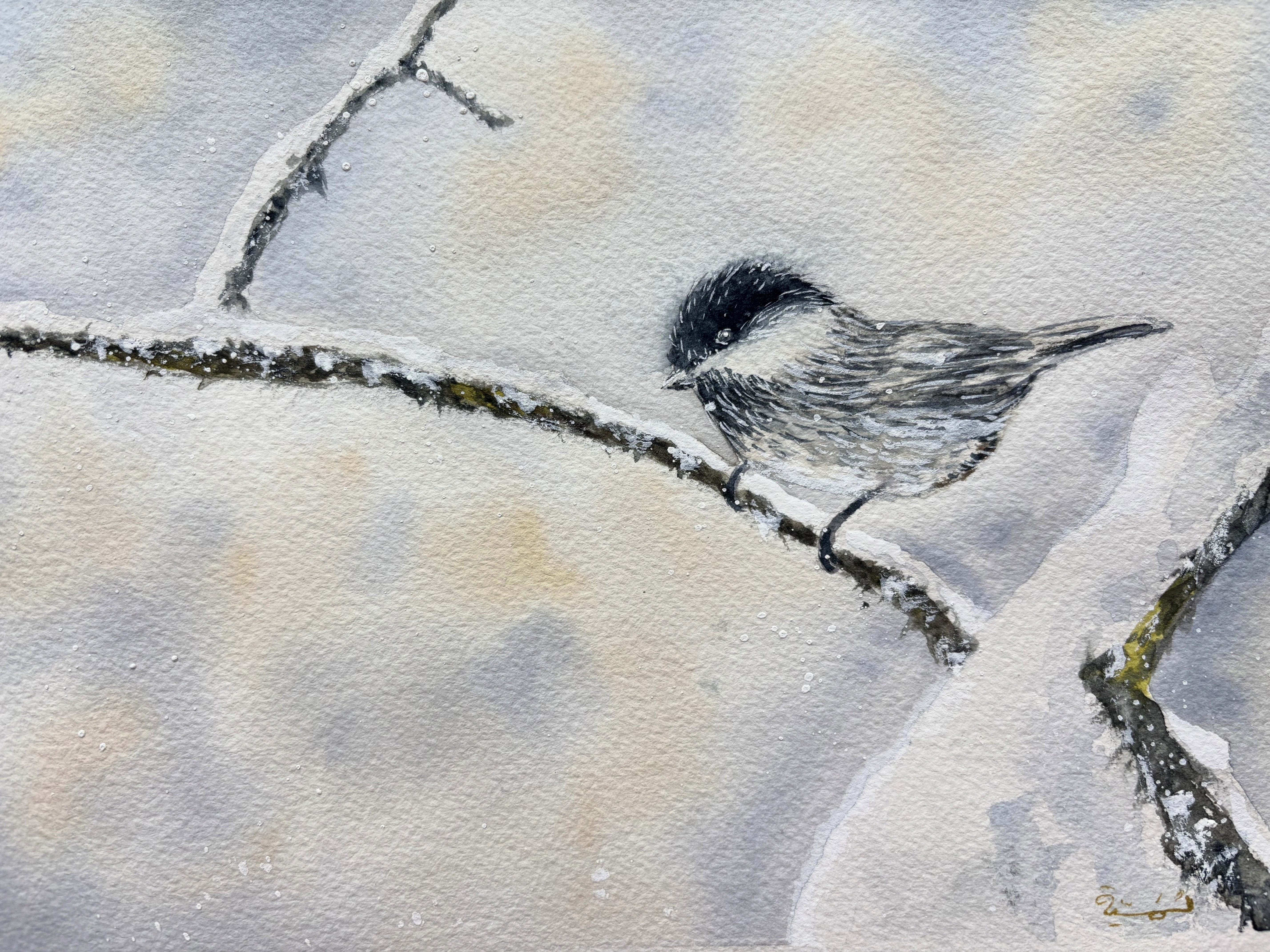
I imagine you
looking down at us
from your quiet perch
on your favorite branch,
and I wonder.

Can you feel
our world
collapsing?

Can you feel
our fear
and the weird hush
blanketing us
like heavy, dirty snow?

Or are you maybe
carrying on
with your life
as usual,
chirping happily
into the sparkly winter sky,

unaware
of all the ways
that we are
already
being torn apart?

If you’re new here, welcome!
However you made your way here, I’m grateful you found me and happy to have you pop into my little world, whether it’s for a brief visit or a longer hangout around my campfire.
Accidental Alchemy is a serial memoir, so if you’re curious and have the time, I recommend starting with the Prologue and reading chapters in order for the full experience. You can access all chapters on my Substack homepage.
For the best reading experience, I recommend reading in a browser and on a larger screen. It makes it easier to enjoy the art and navigate through the chapters with the buttons at the bottom of each post.
If you’re enjoying this memoir, please share with someone you love!
PS.. All art and poetry included in this memoir are my own unless I specifically credit another author or artist.
Oh my goodness Sumaya! I have just spent the last 30 minutes reading about 'occipital neuralgia' which doesn't even touch on the time necessary to understand fully the implications behind such a diagnosis... I felt sick just reading, I can't even begin to imagine the thoughts that ran through your mind when you were finally given the results from the MRI. And, to have been admitted into hospital at that time when we were all so scared of Corona Virus too... I truly don't know if I would have been brave enough to have left my family that day, I really don't...
I am scared by your last sentence too, "The ones that would send me hurtling into the darkness." how can it possibly become worse when you're already living a nightmare of gargantuan size?
I am already poised on the edge of my seat for the next chapter with fearful anticiation...
With love and admiration for you and this courageous beautiful writing.. xxx
Such a deep expression of what it feels like to be inside that kind of panic. Just when we need someone to save us, left more on our own than ever. I feel your exhaustion and your strength. So clearly. Wow.