


Hello, dear ones, and a warm welcome to new readers.
However you made your way here, I’m grateful you found me and happy to have you pop into my little world, whether it’s for a brief visit or a longer hangout around my campfire.
Accidental Alchemy is a serial memoir, so if you’re curious and have the time, I recommend starting with the Prologue and reading chapters in order for the full experience. You can access all chapters on my Substack homepage.
For the best reading experience, I recommend reading in a browser and on a larger screen. It makes it easier to enjoy the art and navigate through the chapters with the buttons at the bottom of each post.

The only Lebanon I knew was a Lebanon at war.
It wasn’t the fabled, glamorous Lebanon of the fifties and sixties, the one people often think of when I say I’m Lebanese. That Lebanon died slowly starting in 1974, when the civil war started. I was only three – too young to remember what came before.
The soundtrack of my Lebanon wasn’t the sound of ocean waves or Western music drifting out of Beirut’s many restaurants and bars. It was the sound of distant gun fire and explosions. The smell of my Beirut wasn’t the sweet scent of jasmine and pine. It was the smell of garbage piled on the streets as basic services collapsed. The sights of my Beirut weren’t the graceful arches of the beautiful old homes in historic downtown, but of the many buildings pockmarked by bullets and shrapnel — the ones my sister and I nicknamed “leprosy buildings.”
“Leprosy building!” we’d yell to each other, pointing excitedly at yet another damaged building as we drove through our Beirut.
My Lebanon was a place infused with a persistent feeling of low-level threat, occasionally punctuated by incidents of real danger.
Incidents like the time a bomb exploded on the ground floor of our apartment building in the middle of the night. I woke up screaming as the window near my bed shattered, my mom jumping on top of me to protect me from the glass and the terrifying noise.
Or the time when an outbreak of fighting forced our entire student body to spend the night in the school’s basement, because it was too dangerous for our parents to pick us up. I can still hear the sound of hundreds of children crying and sniffling, echoing in that cold, cavernous basement. I remember looking around, bewildered, unsure of how scared I should be. Until I saw my older sister crying uncontrollably, which sent me to the floor in a sobbing heap.
These discrete episodes left deep marks. But there was a more subtle reality that may have left an even deeper scar: the strange, uniquely Lebanese phenomenon of constantly spreading word-of-mouth information about where and when the next fighting or bombing would be, which areas should be avoided, and which ones were likely safe.
It was the ever-present hum of a fearful nation desperate for news, desperate for some measure of safety.
I didn’t think much of it at the time. It was how things were. Now I know that that constant hum transmitted an entire country’s fear to its children, like noxious second-hand smoke. It was the air we breathed — the air I breathed.
Despite that underlying hum of fear, my Lebanon was also great fun.
My dad was a bon-vivant. His zest for life, for fun and adventure, was unparalleled. He grabbed life by the balls and expected us to do the same. We were always on the move — horseback riding, hunting and fishing, playing tennis, hiking and skiing (yes, Lebanon has snow and skiing!).
Dad was a jabale, a mountain man. His family — my family — has deep roots in a little mountain village east of Beirut called Hammana. Beirut was where we had to be during the week for work and school, but Hammana was where we spent the times that mattered most. And where we left our hearts every Sunday afternoon and at the end of every summer.
It was also where we gathered with extended family. Dad was one of nine children and they all had kids, so our gatherings were large and boisterous. And funny. Telling jokes is a treasured art form so deeply rooted in Lebanon that it has its own word: tinkeet. To fit in you had to know how to “nekkit,” spending countless hours trading tinkeet back and forth in a gentle, mischievous rhythm that held us together. My body still vividly remembers the feel of that rhythm — the sound of it and the joy of it.
I miss it terribly.

All of this hubbub — the constant adventures and boisterous gatherings — made for a really fun childhood. But it was also overwhelming for a sensitive kid. Especially a sensitive kid growing up in a war zone.
My response was to seek refuge in the silence of the mountains, in the comforting softness of dogs’ coats and horses’ manes, and in the safety of a quiet nook and a good book.
My mom had to pull ticks off me because I was often curled up with one dog or another. My sister joked that my children would one day be m’al’ateen – messy and dirty – because I was invariably in my jeans overalls, covered in dirt and dog hair. (Her prediction wasn’t entirely wrong, dear one. I have two boys, now young men, who are drawn to the wilderness, love camping and mountain biking, are happy to get their hands dirty with manual work, and enjoy curling up with one dog or another—and are therefore often m’al’ateen. And I couldn’t be more proud. )
I made a habit of wandering off alone into the mountains above our house to collect fossils. I would sit in one place for hours, quietly sifting through tiny rocks, waiting for that moment of delight when one of them looked up at me with the tiny face of a beautiful, curled thing and spoke to me of oceans and tides and long ago times.
I never, ever tired of that delight. I spend inordinate amounts of time alone searching for it.
Those beautiful mountains are ancient and brimming with fossils. I collected thousands of them over the course of my childhood. I wish I still had them, but my crazy Aunt Pauline took them after we fled the country and gave them to some distant younger cousins.
“Kilos and kilos of them!” she said laughing.
I loved those mountains and I loved being alone in them. There, in all that blessed quiet and solitude, I felt peaceful. I felt at home.
But they weren’t just a refuge. They were also a source of inspiration. They offered me my first taste of wonder – the wonder elicited by the fossils and their whispers of other times and other worlds. But also the wonder at the scale of the mountains, the depth of the silence, and at the joy of feeling small in all the right ways.
It was there, alone in those mountains, that I became a wanderer and a wonderer. It’s where I began my life-long love affair with solitude and wild places. They became both my refuge and my inspiration. They still are.
I know I’m not alone. I know there are many of us who find respite from an overwhelming world in the quiet stillness of mountains and forests.
The badass goddess of words Mary Oliver got right to the heart of it, to the heart of us, when she wrote:
How I go to the woods

Ordinarily I go to the woods alone, with not a single friend, for they are all smilers and talkers and therefore unsuitable.

I don’t really want to be witnessed talking to the catbirds or hugging the old black oak tree. I have my way of praying, as no doubt you have yours.

Besides, when I am alone I can become invisible. I can sit on the top of a dune as motionless as an uprise of weeds, until the foxes run by unconcerned. I can hear the almost unhearable sounds of the roses singing.

If you have ever gone to the woods with me, I must love you very much.
I laughed out loud the first time I read this poem. Curled up alone in my favorite window seat with a volume of her poetry, I blurted out: “Ha!! Unsuitable smilers and talkers.. hugging old black oak trees… my way of praying. You get me!”
I felt seen. Seen, but also somehow celebrated.
And I have much to celebrate, because it turns out that introversion is a kind of superpower.
In the months and years of darkness that came for me in 2020, I spent an agonizing amount of time alone — far too much for even the deepest introvert. I would cross the threshold between solitude and crushing aloneness again and again.
My capacity to be with silence and solitude may well have saved my life.
But it was my love of wonder that did something even greater: it slowly brought me home to myself so I could reclaim the life that introversion had saved.
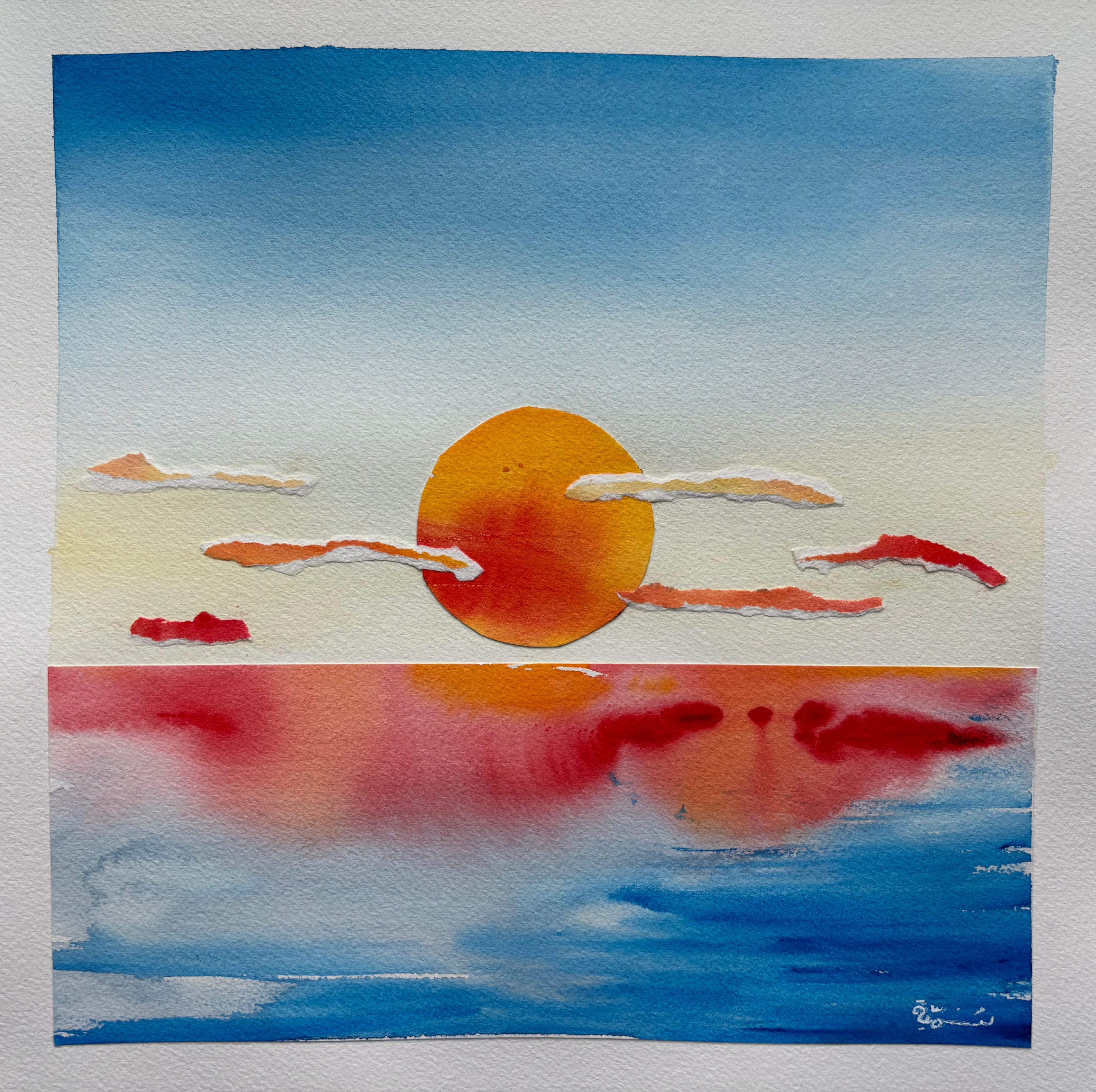
We never know if the sun
is setting or rising,

whether we’re on the cusp
of darkness or light.

It’s a wonder
we care so much.

Straining and struggling
to figure out what time it is

and where exactly we are.
Whether it’s good enough.

It’s a wonder because
right there

in that suspended moment
of right now

is exactly that.
Wonder.

Exactly what we were
looking for all along.
All art and poetry included in this memoir are my own unless I specifically credit another author.
And if you liked this chapter, please….
Ohhh the tears. Your writing feels to me the way Mary Oliver feels to you. I had no idea of your childhood but always sensed you had deep stories. Your light is solidly unique and to stand in it is a gift to this world. My soul for sure. Thank you, from the depths of my soul, for getting these experiences out for us to follow. And to help us all find a way to keep breathing.
Loving your writing style and hearing about your experiences Sumaya!
Have you read The Comfort of Crows? I’m reading it right now and it made me think of what you shared about nature. I think you would like it too:)