


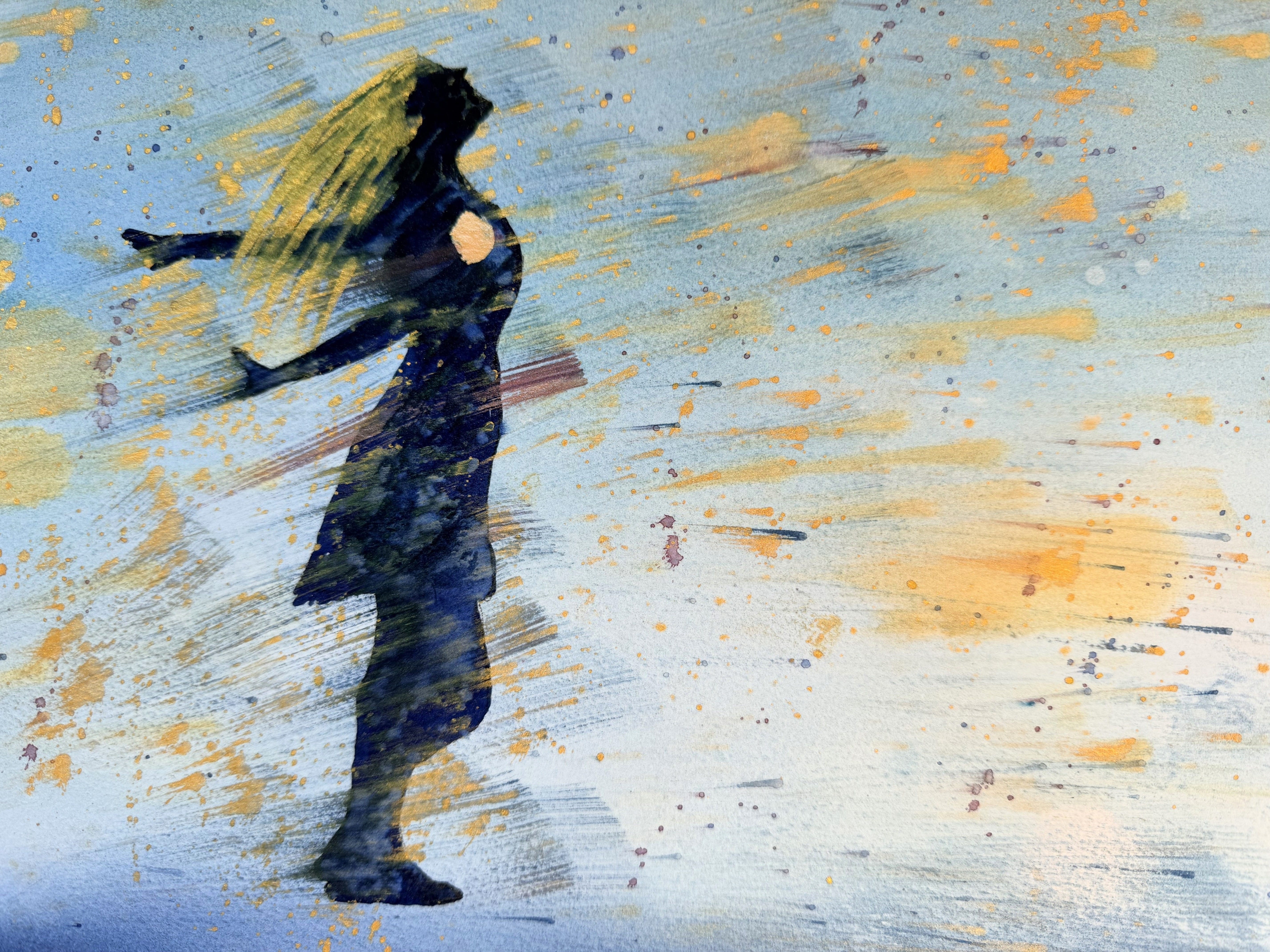
Mindbody healing requires effort and perseverance. But it also requires letting go of attachment to the outcome. It’s an invitation to work hard for change, while also accepting, or even welcoming, things exactly as they are.
I thought it was the unique paradox, and the unique invitation, for those of us “lucky” enough to experience severe neuroplastic symptoms or a Devastating Undiagnosed Neuroplastic Collapse (or DUNC, see chapter 15).
And I thought it was unfair. But that was a silly thought. Or maybe just a self-absorbed one.
Because it’s actually the paradox, and therefore the invitation, at the heart of all human endeavors. And also at the heart of most spiritual traditions and teachings. But maybe I can be forgiven for being blinded by my own experience. Because it’s one thing to read, talk, think about, or dabble in this paradox, but it’s another to have no choice but to live it.
And I had no choice but to live it.
Here’s why.
In order to heal from my neuroplastic (or mindbody) symptoms, I had to work hard at it. The only way forward was doggedly showing up every day and doing the work. No shortcuts. No easy way out.
If I wanted a life where I could dance and run, enjoy my body and my mind, be there for Jason and our boys, and contribute to my community, I had to keep showing up moment by moment and doing the work of rewiring.
I didn’t have a medical team, a treatment plan or a schedule of appointments to keep me on track. Which meant it was just me and my doggedness. Me and my desire to heal. And, as if that wasn’t enough, no one I knew understood neuroplastic symptoms or mindbody healing, or could relate to what I was experiencing. So the showing up was not only hard but also lonely.
[Note: thankfully, the world is changing, and mindbody healing resources and support are proliferating. So if you or someone you love is recovering from neuroplastic symptoms or a DUNC, the road doesn’t have to be as lonely as it was for me.]
That was the first part of the paradox: show up and work harder than I’d ever worked. The second part was surrendering, all while continuing to show up.
The reason is simple: fear.
Fear is the currency of nervous system work—the fuel, sometimes conscious but more often unconscious, that keeps symptoms alive. Which meant that I could work my ass off, but if I did it while gripped by the fear that I would never get well, it wouldn’t work. At least not over the long haul. It might help a little, or even at times a lot, but the underlying condition would always be there, keeping symptoms in place.
I needed to foster a genuine feeling of safety, one that I could ground myself in again and again, to lead my brain—my Tante Sumaya, as I called her (see chapter 15)—to safety. But how could I do that when the physical evidence of my situation pointed to the contrary? How was I supposed to feel safe, and to invite Tante Sumaya into that safety, when I really wasn’t?
It’s not safe to be incapacitated, barely able to lift a pot onto the stove, barely able to maintain a conversation with another human. There was nothing safe about not being able to turn my head or lift my arms above my head. And there was nothing safe about facing a future of incapacitation and isolation.
So where could I turn for solid ground under my feet? Where was safety to be found? The only answer I knew was a spiritual one. Only through a wide enough lens, a cosmic lens, could I see my way to safety no matter what state my body was in, or what state it might remain in.
I wasn’t safe in the physical realm. None of us is. That’s the human condition, whether or not we’re facing health challenges. At any moment, we can be severely injured, emotionally hurt, lose a loved one, lose our home, or lose our livelihood. The possibility of a crushing loss, even the loss of our life, is always right around the next corner.
That’s the bargain we’ve made with the cosmos: no guarantees. Ever. Therefore, no real safety in the physical world. Which is why the only true safety is spiritual.
I had a taste of unconditional safety when I hit rock bottom and was caught by my cosmic safety net (see chapter 12). Since that day, that safety net had morphed into a palpable presence in my life—a palpable feminine presence that caught, loved and guided me. I felt held by a cosmic undercurrent that guaranteed me access to peace, love, wonder, delight, and joy. No matter what.
It’s all there in my very makeup, in the stuff I am made of. The stuff we’re all made of.
So the invitation was to trust that invisible and unknowable stuff. To take a great leap of faith into a spiritual reality that contradicted my physical one. It was an invitation to fall back into the loving arms that had already caught me more times than I could count and to trust that I would be caught yet again. And to trust that the catching woundn’t be what I expected, or even what I wanted. Which is the whole point.
The whole endeavor was about letting go of control and trusting that something far greater than me had my back even when it felt like she didn’t. That was the only solid ground on which I could stand to access a true feeling of safety. And only from that solid ground could I take the lead and guide Tante Sumaya back to safety as many times as it would take to unwind the neuroplastic symptoms that had taken me to my knees.
Thus the importance of surrender.
But I dislike the word surrender. It’s a grim word. It speaks of armies, war and waving white flags. It speaks more of defeat and giving up than of the beautiful feeling of trust and letting go. It’s just not a warm and fuzzy word and it makes the whole endeavor that much more daunting. At least for me.
So I started using the word “trustfall.”
It felt more true for me, more true to how I had to take my hands off the wheel of my own life, muster up my courage, and fall back into an invisible unknown. It speaks of the trust I cultivated that I would be caught and that there would be unexpected gifts in the catching.
That said, I know we might be stuck with the word surrender, since it’s already in our common lexicon and therefore hard to change. But now you know, dear one, that in my private moments and in my inner world, I think of it as trustfalling.
No matter what I call it, there was nothing easy about it. There still isn’t.
Sometimes, the way we talk about surrender makes it sound like something we do once and then get on with our sparkly, magical life. That’s not how I experienced it. It wasn’t something I did once, checked the box and then exhaled a giant sigh of relief. It was something I had to find my way to—and continue to find my way to—again and again. Sometimes numerous times a day.
Maybe there are spiritual masters out there who surrender once and become enlightened from that moment on. I’m honestly not sure. What I am sure of is this: I am not one of them. And I don’t plan to be. I plan to continue being an ordinary human, stumbling about in this messy human existence like most of us are. Because I actually think the stumbling about—and the messiness—is the whole point.
But so is waking up to a bigger reality and surrendering to it as often as possible, even while we stumble about.
Sometimes that surrendering felt easy, as natural as breathing. So natural that I thought I would never forget how it felt or how to do it.
Then I’d forget. Really forget. And the letting go would be hard. Really hard.
Thankfully, I didn’t have to do it alone. I had my horses. And I had my phone.
First, a bit about horses. They are extraordinary. I’m pretty sure they’re here to support us humans to get our heads out of our bums and feel what the world is really made of. That’s what they’ve done for me. Which is why they’re my greatest teachers. I spent large portions of my day with them in those early days of rewiring. They reminded me of what I needed to know whenever I forgot. Or they held me lovingly while I stumbled about in my forgetting, unable to find my way to anything else.
Second, a bit about my phone. Given that I still couldn’t focus, read, or talk for very long—and that car rides were still hard and I lived in the middle of nowhere—my phone was a lifeline. It connected me to the people, ideas and tools I needed for both the hard work of rewiring and the hard un-work of surrendering.
I came to think of it as “my little rectangle of hope.” And it deserves its very own chapter section, so here goes.
My little rectangle of hope
I know we all have a lot to say about the evils of technology. We wring our hands about the brain rot, the echo chambers, the bullying, the damage to democracy, the fact that so few people read books anymore. And rightly so.
But as I made my way through my healing adventure, I developed an outsized gratitude for my smartphone. I started thinking of it as my “little rectangle of hope.”
I borrowed the phrase from my dear friend Dina, who teaches yoga and would refer to yoga blocks as “little rectangles of hope”. Which used to make me laugh right in the middle of yoga class. So I borrowed the name. Because I can’t even imagine how I would have managed without my phone, without the hope and support that it beamed into my little house in the mountains. Every little app on my home screen was a lifeline. A lifeline to hope.
First, there were the apps, podcasts and YouTube channels that shared knowledge and tools about neuroplastic symptoms and nervous system work. There were many, but the one that may well have saved my life was the Curable app, with its extraordinary resources and guidance, and its “panic” button for support during the hardest days and moments.
Then there were the teachers and courses that offered both nervous system regulation tools and spiritual guidance and insights—the ones that I came across “out of the blue”, when I needed them most: a yoga nidra meditation course with a sweet and goofy guy named Richard Miller; Qi Gong classes and a breathwork course with a sweet and goofy guy named Lee Holden; an Internal Family Systems course with—dare I say it again?---a sweet goofy guy named Dick Schwartz (the founder of IFS).
These teachers and courses were life-changing. I still practice what they taught me every day. I no longer do it because I need to. I do it because I want to. I do it because these practices aren’t just remedial, but also supportive of health and wellbeing—physical, emotional and spiritual—far beyond rewiring nervous systems.
But that wasn’t all. My phone also offered up support for the surrender part of the impossible paradox. When I ran out of hope and couldn’t find my way to surrender, which was often, I listened to audiobooks and podcasts that inspired me to keep going, but also inspired me to open my heart to my experience and to the gifts it offered.
I listened to memoirs by Elizabeth Lesser, Elizabeth Gilbert, and Suleika Jaouad. Their stories inspired me and gave me courage. And they felt like friends who walked beside me when I was lost. And I listened to books and podcasts by spiritual teachers like Pema Chodron, Eckhart Tolle, Michael Beckwith, Mark Nepo, and Richard Rohr—teachers who pointed me to the big picture again and again.
It was easier to surrender when I had guides who inspired me, guides who stood on the shoulders of generations of teachers and traditions. They reminded me that many had walked dark paths before me and found their way to surrender. On the hardest days, they held that possibility for me when I couldn’t hold it for myself.
I’m still awestruck at how all these resources and programs found their way to me in unexpected ways at just the right time. It felt like a beautiful, cosmically-inspired, healing curriculum made just for me.
So we can carry on with our doomsdaying about the evils of technology. Heaven knows there’s plenty to fret about, especially with artificial superintelligence barreling our way.
But I’ll happily get down on my knees every day and thank my lucky stars that I got to live at a time when we humans got so smart that we can conjure healing, hope and spiritual growth from a little rectangle of metal and glass.
If we hadn’t, I wouldn’t be writing and sharing this memoir. I wouldn’t be doing much of anything. I would still be stuck in a dark place, incapacitated, depressed and lonely.
So three cheers, and maybe a little “huzzah!”, for my little rectangle of hope. And maybe yours too, dear one.

If you’re new here, welcome!
However you made your way here, I’m grateful you found me and happy to have you pop into my little world, whether it’s for a brief visit or a longer hangout around my campfire.
Accidental Alchemy is a serial memoir, so if you’re curious and have the time, I recommend starting with the Prologue and reading chapters in order for the full experience. You can access all chapters on my Substack homepage.
For the best reading experience, I recommend reading in a browser and on a larger screen. It makes it easier to enjoy the art and navigate through the chapters with the buttons at the bottom of each post.
If you’re enjoying this memoir, please share with someone you love!
PS.. All art and poetry included in this memoir are my own unless I specifically credit another author or artist.
There is so so much wisdom in this dear Sumaya, from "Sometimes, the way we talk about surrender makes it sound like something we do once and then get on with our sparkly, magical life." to your 'little rectangle of hope'!
Surrender is both a physical and emotional in so many cases, hard to accept during and often even harder afterwards for what ever the reason, but, why should it be so heartbreakingly hard when our bodies are crying out for just that? It is a question I put to my husband many times after his own life changing accident and still he has immense difficulty in accepting.
As for our little rectangles of hope... I have one of those too, I think for those of us that live outside of mainstream everything they are our lifebuoys more often than we give them credit for and if there is one thing high tech I don't begrudge its my phone.
I loved this resonant chapter dear one... thank you.
I hope your weekend is behaving beautifully — sending hugs ♥️xx
Yes! This little rectangle of hope has served me in my darkest hours. Apps like Headspace, InSight Timer, and especially my beloved “The Tapping Solution” have been such saviors. Not to mention 8 hour sleep meditations on YouTube and the voice memo function that allows me to journal when my head and hands wouldn’t allow me.